
By Vijay Soni · Reviewed by Dr. Ashish Sachdeva BAMS · Last updated 12 November 2026
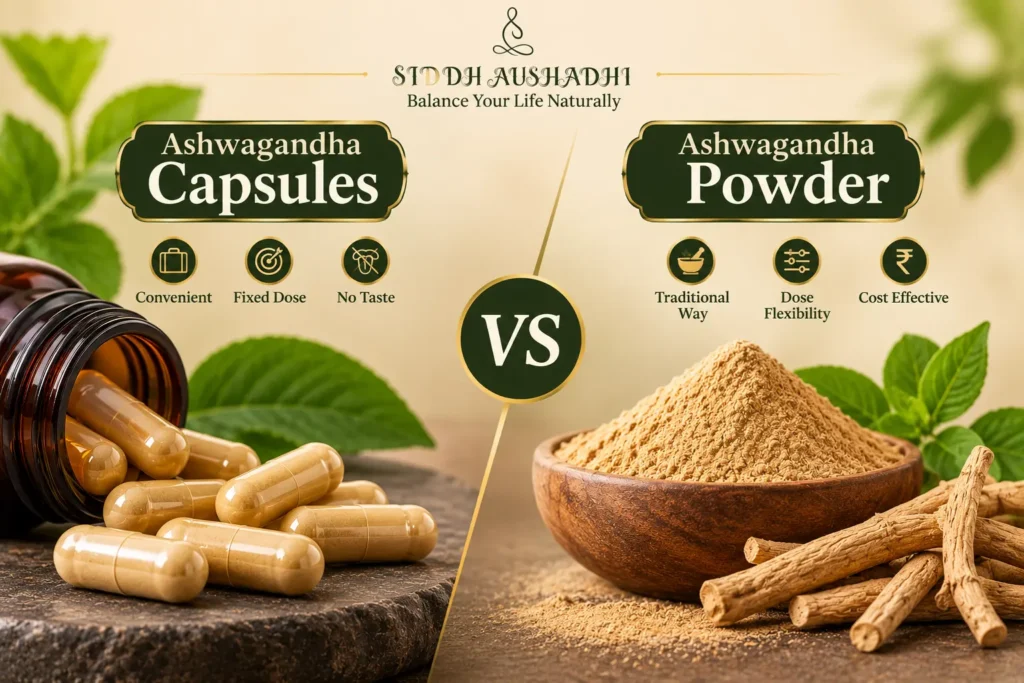
Neither form is better for everyone. Capsules give a fixed dose with no taste and suit busy routines, while powder often costs less, lets you adjust the amount and follows the traditional way of taking it with warm milk. Check the label for root powder or standardised extract, because milligram doses differ between forms.
Ashwagandha capsules vs powder at a glance
| Capsules | Powder | |
| Dose accuracy | Fixed amount in every capsule | Depends on how you measure it |
| Taste | None | Earthy and bitter |
| Convenience | Easy to carry and take | Needs measuring and mixing |
| Dose flexibility | Limited to the capsule size | Easy to adjust |
| Cost | Often higher per serving | Often lower per serving |
| Traditional use | Modern format | The traditional way, often with warm milk |
| What to check | Whether it holds powder or extract and the capsule ingredients | Freshness, moisture and microbial testing |
What is the difference?
Both come from the ashwagandha plant and both carry the same cautions. The real difference is how the product is made and taken.
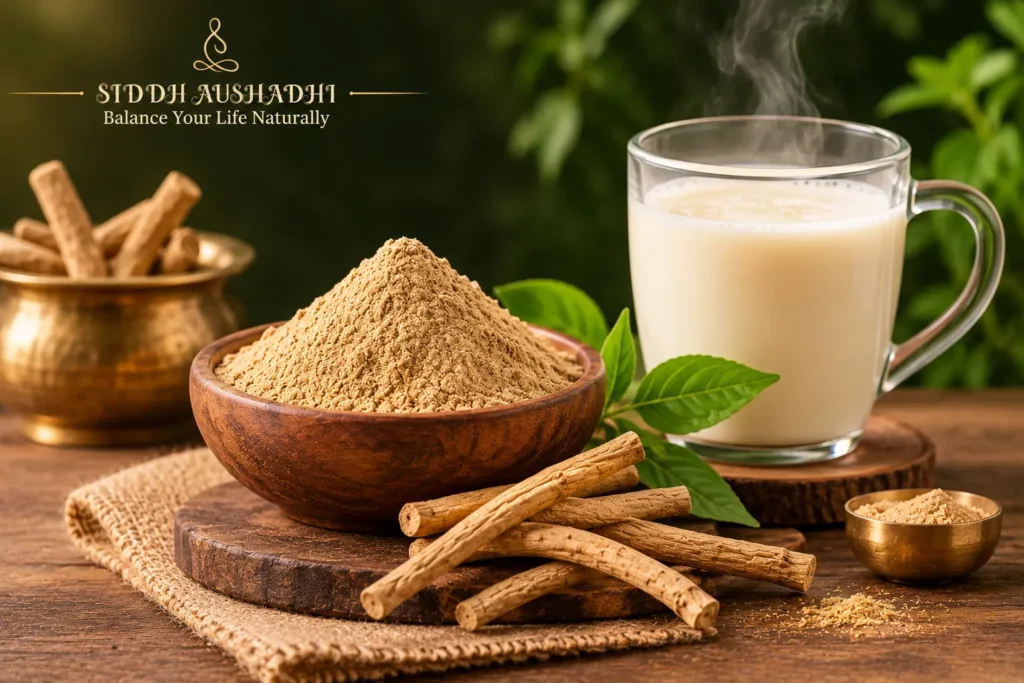
Powder is dried, ground ashwagandha root, often called churna. People stir it into warm milk or water, and doses are measured in grams.
Capsules hold a set amount of either plain root powder or a concentrated extract. Doses are measured in milligrams.
Extracts are more concentrated than plain powder, so 300 mg of extract does not equal 300 mg of powder. Our guide to ashwagandha dosage for men explains how doses differ by form.
What does the research say?
Most trials of ashwagandha used standardised root extract in capsules or tablets. Studies that directly compare capsules with powder are limited, so no one can say that one form works better. Be careful with claims of “better absorption”, which brands often make without direct comparison data.
What matters more is the amount of the active compounds you actually take and whether the product is well made.
Who suits capsules?
- People with busy routines or who travel
- Anyone who dislikes the bitter taste
- People who want the same amount every time
Read the label closely. A capsule may hold plain powder or an extract and the shell may contain other ingredients.
Who suits powder?
- People who like the traditional way of taking it with warm milk
- People who want to adjust the amount
- Anyone who wants a lower cost per serving
Measure powder with a proper measuring spoon or a small kitchen scale, because the weight of a teaspoon varies.
Quality checks for each form
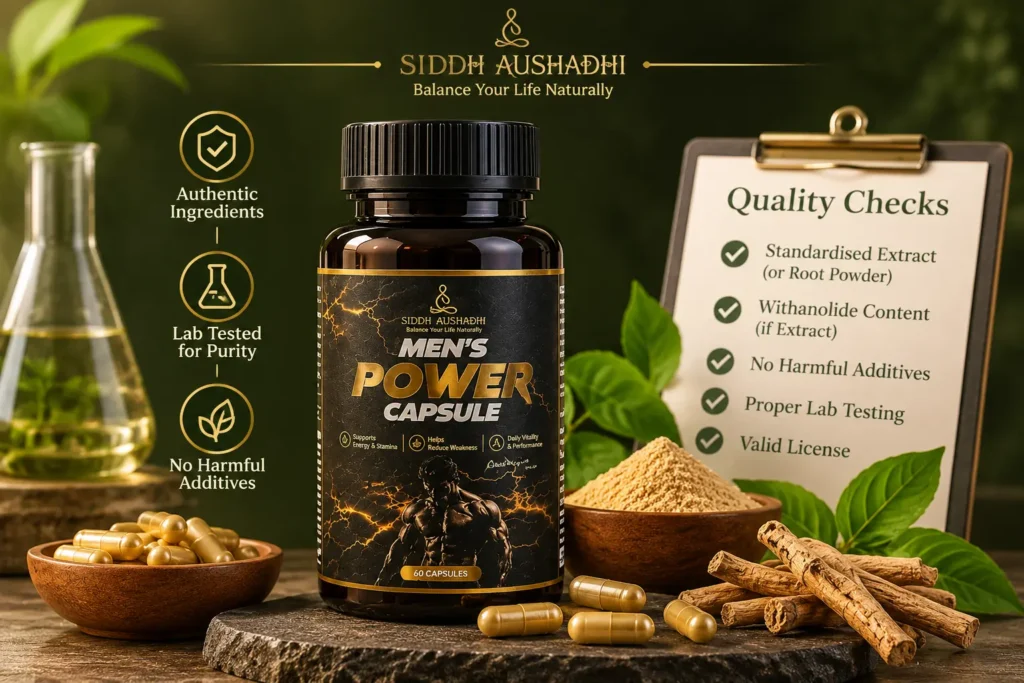
Capsule checks:
- Check whether the label says root powder or standardised extract, and the amount per capsule.
- Look for the withanolide percentage if it is an extract.
- Read the list of other ingredients.
Powder checks:
- Check that the pack names the plant part and the origin.
- Buy a sealed pack with a batch number and expiry date, and ask for a batch lab report for microbes and heavy metals.
- Keep it dry and closed, and use a dry spoon so moisture does not spoil it.
For both forms, confirm the manufacturer’s name and licence numbers. Our guides on how to check authentic Ayurvedic products and how to choose an Ayurvedic supplement for men explain how.
Capsules or powder for the gym?
Neither form has been shown to work better for training. For recovery, consistency, the right dose and a well-made product matter more than the format. Our guide to ashwagandha for gym recovery covers what the research says. For timing, read the best time to take ashwagandha.
Side effects and who should be careful
The form does not change the cautions. Check with a doctor before you start if you:
- have a thyroid, liver or autoimmune condition
- take sedatives, or blood pressure, diabetes or thyroid medication
- are pregnant or breastfeeding
- have surgery planned in the next two weeks
- are under 18
Stop taking it and see a doctor if you notice yellow skin or eyes, dark urine or severe stomach pain. Our guides to ashwagandha benefits for men and whether Ayurvedic supplements are safe explain more.
Frequently asked questions
Neither is better for everyone. Choose capsules for convenience and a fixed dose or powder for flexibility, lower cost and the traditional method. Quality and the right dose matter more than the form.
No direct comparison proves that one works better. Most trials used standardised extract and plain powder is less concentrated, so the amounts are not the same.
Usually yes for plain powder capsules, but it tastes bitter and you lose the convenience. Check the label first and follow its directions.
You cannot convert them reliably. Extract is concentrated and the weight of a spoon varies. Follow the label of the product you use.
Only if you add up the total and stay within the label dose. Taking both at full dose doubles your intake.
The herb carries the same cautions in either form. Some people find powder on an empty stomach harder on the stomach, so take it with food.
A good place to start
If you prefer capsules, Men’s Power Capsule gives a fixed serving. Each 825 mg capsule lists 250 mg of ashwagandha alongside shilajit, white musli, gokshur and other herbs and the label directs one capsule twice daily after meals.
This article is for general information and does not replace medical advice. Our products are general wellness supplements, not for medicinal use. Speak with a doctor before starting any new supplement, especially if you have an existing health condition or take regular medication.