
Ayurveda has used Ashwagandha, an adaptogenic herb, for centuries to help the body handle stress. For men, it’s most often taken to support everyday stamina, muscle strength, sleep quality and steady energy. It’s not a quick fix, but something you take consistently over weeks. It’s generally well tolerated, though it can cause mild stomach upset in some people.Avoid it during certain health conditions or alongside certain medications (more on that below).
1. What is Ashwagandha, exactly?
Ashwagandha (Withania somnifera) is a small shrub whose root has been used in Ayurvedic medicine for centuries, usually ground into a powder or extracted into capsules. The name translates roughly to “smell of horse,” a nod to both its distinctive smell and the traditional belief that it gives the strength and vitality of a horse.
Modern interest in Ashwagandha has grown alongside a wider look at adaptogens, herbs believed to help the body adapt to stress. It’s now one of the most studied herbs in Ayurvedic wellness, with a small but growing body of clinical research behind it.
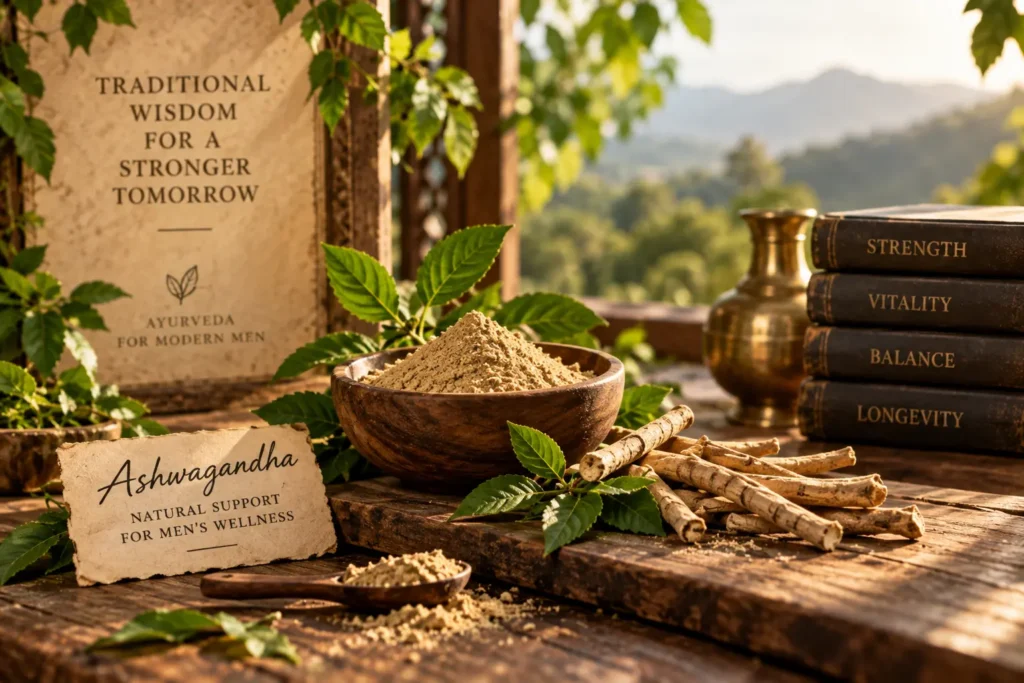
2. Ashwagandha for stamina and strength
This is the reason most men start taking Ashwagandha in the first place.
- Stamina and endurance. Men traditionally take Ashwagandha to support physical endurance and reduce the feeling of fatigue during sustained activity, whether that’s a workday on your feet or a training session.
- Muscle strength and recovery. Men who train regularly commonly use it, as part of a broader recovery routine alongside proper sleep, hydration and nutrition, not as a replacement for any of those.
- Sleep and stress. Because Ashwagandha is an adaptogen, its best-documented traditional use is in supporting calmer, more consistent sleep and helping the body manage everyday stress, both of which directly affect how much stamina and strength you have the next day.
- Steady energy. Unlike caffeine, Ashwagandha isn’t a stimulant. Men often describe the effect as steadier energy over the day rather than a short burst.
None of this makes Ashwagandha a substitute for training, sleep or diet – it’s a support, not a shortcut. Results build gradually over several weeks of consistent use rather than overnight.
3. How much Ashwagandha should you take?
Typical doses range from 300–600 mg of a concentrated root extract per day. The right amount varies by product concentration and formulation. People usually take powder forms in larger quantities… mixed into milk or water or water, a more traditional method.
Always follow the dose printed on the specific product you’re using. Concentration varies a lot between brands and extract types, so a ‘normal’ dose for one product can be too much or too little for another.
4. Best time to take Ashwagandha
There’s no single correct time – it depends on what you’re taking it for:
- For sleep and recovery: most men take it in the evening, roughly 30–60 minutes before bed.
- For daytime stamina and stress management: taking it in the morning with breakfast works well, since it’s non-stimulating and won’t disrupt sleep.
- Some people split the dose, taking half in the morning and half in the evening, particularly at higher total doses.
- Take it with food if you notice any stomach sensitivity, this is the single most common fix for mild digestive discomfort.
Consistency matters more than exact timing. Ashwagandha works cumulatively, so a consistent daily time matters more than which time you pick.

5. Ashwagandha side effects
Most people tolerate Ashwagandha well at recommended doses, but it isn’t risk-free for everyone. Reported side effects include:
- Mild digestive upset, nausea or loose stools, especially on an empty stomach or at higher doses
- Drowsiness, particularly when taken in larger amounts
- Rare reports of liver-related issues, generally linked to very high doses or pre-existing liver conditions
Ashwagandha is not recommended or should only be used under medical guidance, if you:
- Have an autoimmune condition (it can stimulate immune activity)
- Have thyroid issues, since it may affect thyroid hormone levels
- Have liver disease
- Have surgery scheduled in the next two weeks (it may affect the central nervous system and interact with anaesthesia)
- Are taking sedatives, thyroid medication or immunosuppressants
This is general information, not medical advice specific to you. If you have an existing health condition or take regular medication, check with a doctor before starting Ashwagandha and stop use and speak to a doctor if you notice anything unusual.
6. Who should be more cautious
- Men with existing autoimmune, thyroid or liver conditions – check with a doctor first.
- Anyone already on prescription medication – particularly sedatives, thyroid medication or immunosuppressants – should confirm there’s no interaction.
- If you’re new to Ashwagandha, start at the lower end of the dose range for the first week or two and see how your body responds before increasing it.
Frequently asked questions
Some early research has looked at Ashwagandha’s effect on markers linked to male hormonal health, but this is an active area of study rather than a settled claim. It’s best understood as a general wellness and stress-support herb rather than a testosterone product.
Yes, it’s typically taken daily and works best with consistent, ongoing use rather than occasional use. Many people take it in cycles (for example, a few months on, a short break) though continuous daily use is also common, check the guidance on your specific product.
Most people notice gradual changes, in sleep, stress and energy – over 2 to 6 weeks of consistent use, rather than immediately.
These are commonly combined in Ayurvedic formulations, but always check that a combined dose stays within safe limits for each ingredient and check with a doctor if you’re combining multiple new supplements at once.
This article is for general information and does not replace medical advice. Speak with a doctor before starting any new supplement, especially if you have an existing health condition or take regular medication.
A Good Place to Start
If you’d like to try Ashwagandha alongside the other ingredients covered here, have a look at Men’s Power Capsule here: https://siddhaushadhi.com/product/mens-power-capsule/
And if you’d like to buy Ayurvedic products online including the Men’s Power Capsule the full Siddh Aushadhi range is at https://siddhaushadhi.com/.